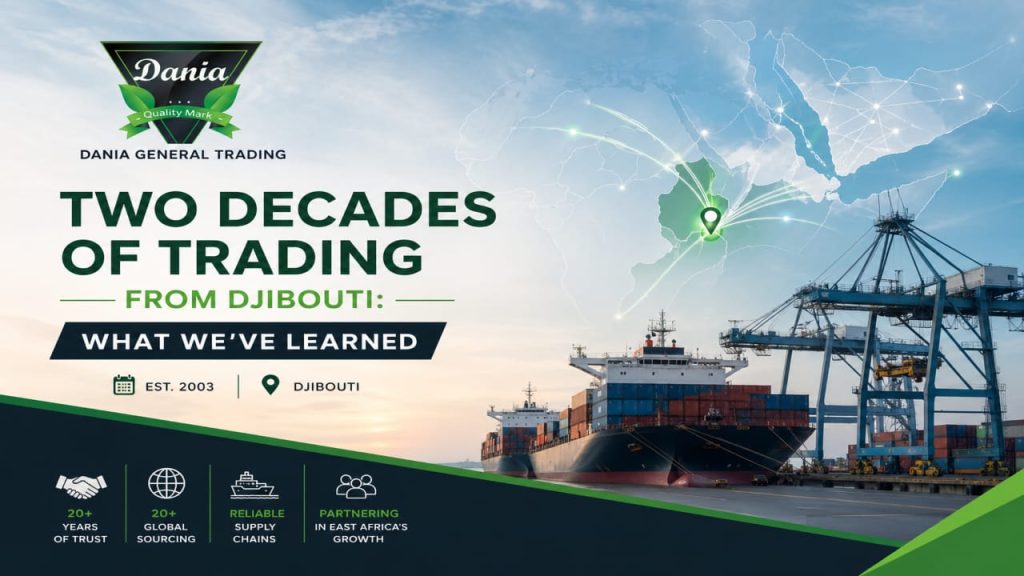
When Dania General Trading was established in 2003, Djibouti was already a strategic port city but the infrastructure and trade volumes that define it today were still taking shape. There was no standard-gauge railway to Addis Ababa. The Doraleh Multipurpose Port did not yet exist. Sourcing from twenty countries simultaneously was not something a regional trading company would have considered a baseline expectation.
More than two decades later, we are still here and the market has changed in ways that would have been difficult to fully anticipate in 2003. This piece is not a corporate anniversary announcement. It is a genuine reflection on what operating from Djibouti for over twenty years has taught us about food commodity trading, supply chain reliability, and what it actually takes to serve wholesale buyers across East Africa consistently and well.
1. Geography Is Not Just an Advantage It Is a Responsibility
Djibouti sits at the mouth of the Red Sea, adjacent to the Bab-el-Mandeb strait, through which approximately 30% of global merchant shipping passes each year. It is one of the most strategically positioned logistics nodes in the world, and it serves as the primary port gateway for Ethiopia a country of over 120 million people with more than 90% of its total trade volume moving through Djiboutian facilities.
The Doraleh Container Terminal handled 1,236,769 TEU in 2024, breaking the one million mark for the first time (African Business) a milestone that reflects how dramatically the port’s throughput has grown since we started operating here. The Doraleh Multipurpose Port, which specialises in solid, mineral, and agricultural bulk cargo, handled 3.4 million tonnes of goods in 2024 alone, a volume up 12% year on year (African Business).
We are beneficiaries of that infrastructure but being based here also means we carry an obligation. When a buyer in Addis Ababa or Hargeisa places an order for rice or sugar, their supply chain runs through this port. If we manage our operations poorly, the consequences travel downstream immediately. That sense of responsibility has shaped how we work every day since 2003.
2. The Addis Ababa Corridor Changed Everything
One of the most transformative developments of the past decade has been the completion of the Ethiopia-Djibouti Railway. The 753-kilometre electric railway, completed in 2018, cut freight transit time between Addis Ababa and the Port of Djibouti from more than three days to under 20 hours(African Business).
For us, that was not just an infrastructure milestone it was a fundamental shift in how quickly we could serve Ethiopian buyers and how reliably we could commit to delivery timelines. What had previously required careful planning around road transport and border crossings became considerably more predictable.
We have learned, however, that infrastructure improvements create demand as much as they meet it. Ethiopia’s appetite for imported food commodities has grown alongside improved logistics access. Ethiopia’s economy grew at an average annual rate of 9.9% over the past decade, compared to a regional average of 5.4%. A growing, urbanising population means growing demand for rice, wheat flour, edible oil, sugar, and pulses the core commodities we supply. Managing that demand growth while maintaining supply quality and price competitiveness requires active supply chain investment, not just geographic luck.
3. Single-Origin Sourcing Is Always a Risk Waiting to Materialise
In our early years, the global food commodity market was less volatile than it has become. Supply chains were more predictable, freight costs were lower, and export restrictions from major producing countries were relatively rare events.
That world no longer exists.
Over twenty years of active commodity trading, we have seen monsoon failures reduce rice harvests in India and Pakistan. We have watched Indonesia and Malaysia adjust palm oil export policies in response to domestic biodiesel mandates. We have seen the Black Sea become a contested zone for sunflower oil exports. We have experienced Red Sea routing disruptions that added transit costs and time to shipments from South Asian origins.
Each of these events tested trading businesses that had concentrated their sourcing in a single origin or had not built alternative channels in advance. The lesson which we learned early and have reinforced many times since is straightforward: for every core commodity, you need active relationships across at least two origin markets before you need them, not after.
Today, we source across more than 20 countries globally. That diversity is not a marketing talking point. It is the mechanism by which we have maintained supply continuity for our clients through market conditions that have derailed less-prepared operators.
4. Scale Creates Access, and Access Protects Our Clients
There is a threshold in commodity trading above which your scale changes your relationship with producers and refineries. When you move substantial volumes consistently, you become a priority buyer not just another order in the queue.
Today, Dania moves over 40,000 metric tons of sugar alone every month. We operate as the region’s only continuous breakbulk supply chain, purpose-built to ensure our clients never face commodity shortages on their most critical products. At that volume, we are not a transactional buyer for the world’s leading refineries and mills. We are a preferred partner and that relationship comes with meaningful advantages: priority allocation during periods of constrained supply, preferential pricing that we pass directly to our wholesale clients, and early visibility into supply conditions before they affect open market prices.
This took years to build. But it is one of the clearest lessons of two decades in this market: scale is not only about efficiency. It is about the quality of the relationships your scale enables, and ultimately about the protection those relationships provide to the businesses that depend on you.
5. Own Brands Are a Form of Accountability
Several years ago, we made a decision that some trading companies never make: we put our name on products. Shikra Premium Basmati Rice, Dania Classic Basmati, Arkee Basmati, Dania Pure Sunflower Oil, Dania Pure Palm Oil these are not just labels. They are a form of public accountability.
When a brand appears on a product on a retailer’s shelf, it is no longer possible to pass responsibility for quality to someone else in the chain. You own the specification, you own the consistency, and you own the relationship with the end consumer. That discipline has made us more rigorous as a sourcing organisation because our own name is at stake with every shipment.
For our wholesale clients, our branded products also offer a practical advantage: consistent specifications across orders. When a buyer sources Dania-branded rice or oil, they know exactly what they are receiving. That consistency matters in retail and food service contexts where product variation creates operational problems.
The Next Chapter
The trading environment of 2026 is more complex than 2003 in almost every dimension: more volatile commodity markets, more sophisticated buyer expectations, more demanding logistics conditions, and more competition at every level of the supply chain.
Djibouti’s port ecosystem has grown to seven specialised facilities, cementing its position as a rare logistics model on the African continent(African Business) and that trajectory gives us confidence in the foundation on which we operate. The infrastructure is strengthening around us. Our sourcing relationships span more origins than ever. Our commodity portfolio continues to expand.
What does not change is our approach: active sourcing, transparent communication, and supply continuity for the wholesale buyers and distributors who depend on us across East Africa.
Talk to Our Team
If you are a wholesale buyer, distributor, or procurement manager looking for a reliable food commodity supply partner in East Africa, we welcome the conversation. Contact our commercial team via WhatsApp at +253 77 19 42 22, by email, or through the contact form on our website.
Dania General Trading SARL Salam Tower, Office #704 & #720, Republic of Djibouti